"Because CPI does not fully cover the cost of running and operating a floating home marina." That was Becky Smith, property manager at Waldo Point Harbor, explaining to the Marin Independent Journal in July 2025 why the marina had relied on larger rent increases when homes sold. A few months later, that reasoning was written into state law.
CalMatters Digital Democracy reports that AB 754 was chaptered on October 10, 2025, and took effect January 1, 2026. For anyone buying a floating home in Sausalito today, its main effect is simple to say and easy to miss. The berth rent you'll pay is not just whatever the seller pays. The marina may set a new rate at the sale, up to a ceiling based on the seller's rent and the price you agree to. Whether that reset is available at all depends on the lease the seller held.
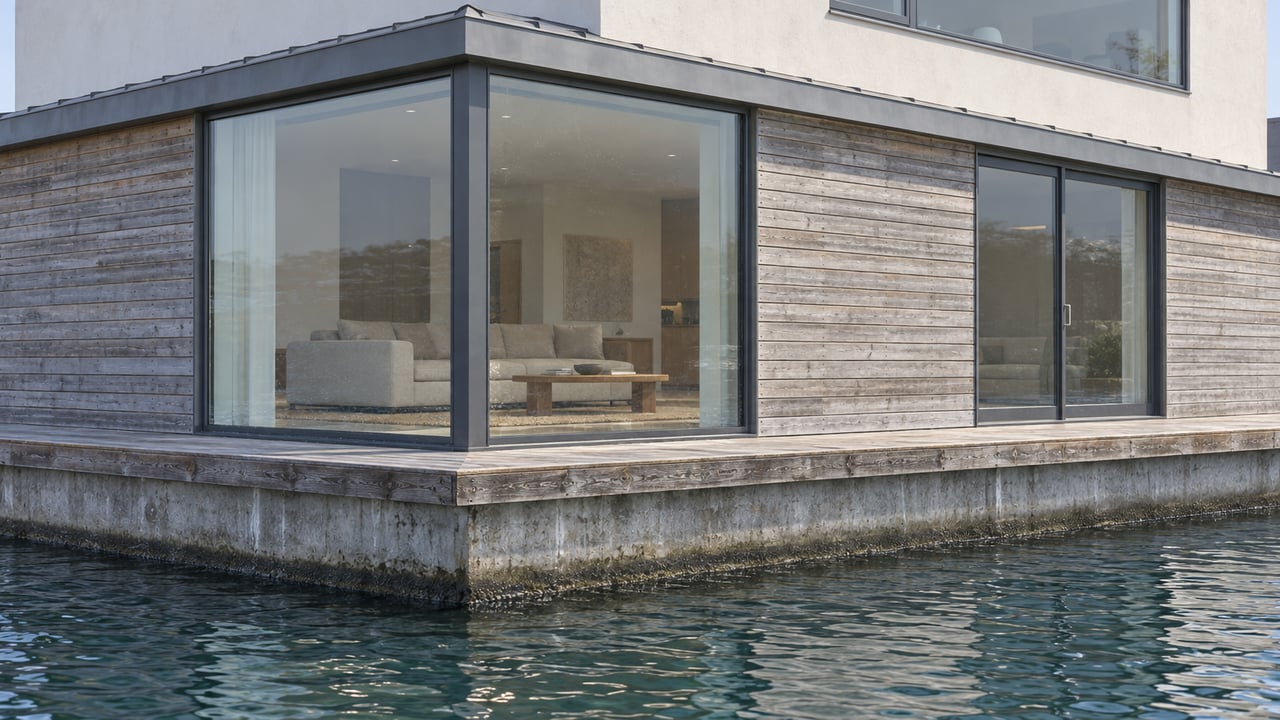
Every floating home in Marin County is in Sausalito. The Marin IJ counted 425 of them across five marinas in 2025. Waldo Point Harbor alone has 282 berths. It describes itself as a privately owned marina where the homes are privately owned, every home has a berth lease, and all berths are occupied. You buy the home, and you rent the water it sits on. The second cost is the one the list price doesn't show.
The berth rent can be reset at the closing table
When a qualifying home sells and stays at the same berth, AB 754 lets the marina set a "new initial rental rate" for the buyer. That rate cannot exceed the lesser of two figures:
- a 25 percent increase over the seller's rent, or
- 0.15 percent of the home's sale price.
If that formula produces an increase below 3 percent, a different cap applies. The new rent can go up to the seller's rent plus the latest cost-of-living change, with a minimum of 3 percent and a maximum of 5 percent. The buyer must also certify the final sale price to the marina in writing, under penalty of perjury. Because the sale price feeds directly into the rent ceiling, the marina has a legal reason to know the true number.
The first-sale formula doesn't use the word "monthly." The companion rule for a second sale within five years does refer to "total monthly initial rental rate." The examples below treat the result as monthly rent. They use made-up figures to show how the formula behaves. They are not actual marina rents, which our research could not verify for any specific berth.
| Hypothetical sale | Seller's monthly rent | 25% over seller's rent | 0.15% of price | Buyer's ceiling |
|---|---|---|---|---|
| $900,000 home | $1,000 | $1,250 | $1,350 | $1,250, the 25% cap applies |
| $700,000 home | $1,000 | $1,250 | $1,050 | $1,050, the price cap applies |
| $800,000 home | $1,300 | $1,625 | $1,200 | Below a 3% increase, so the CPI cap of 3% to 5% applies, about $1,339 to $1,365 |
Look at the first two rows. The seller's rent is the same, but the sale prices differ by $200,000, and so do the buyer's rent ceilings. A marina may charge less than the ceiling. The law only limits how high the new rate can go. Below the point where the 25 percent cap takes over, each additional $10,000 of sale price raises the possible berth rent by $15 a month. Within that band, negotiating the price also means negotiating the rent. The third row shows the opposite case. When the seller's rent is already high relative to the price, a lower price doesn't bring the rent down. The ceiling simply falls back to a modest cost-of-living increase.
Why the seller's lease file matters more now than it did in June
The reset is allowed only if the seller held a lease of 10 years or longer, or was offered one between two years and six months before the sale. Any lease offered after the transfer must also run at least 10 years.
For the first year, that condition was waived. The formula applied to every in-place sale between July 1, 2025 and July 1, 2026, whatever lease the seller had. That window closed three months ago. For a sale this October, the seller's lease history is part of the deal again, and it should be documented before you price an offer.
The lease-length rule has a history. The earlier law, AB 252, passed in 2022 after Barnhill Marina in Alameda was acquired in 2021 and imposed rent increases as high as 178 percent. It capped annual increases at 3 percent plus CPI, up to 5 percent, and barred any rent increase when a home sold in place. Before that law, most floating home owners held leases of 10, 20 or even 30 years. Afterward, marinas began moving residents to one-year terms and adding new fees to make up for the revenue they could no longer collect at resale. AB 754 reverses that trade. Marinas get a capped reset at sale, and residents get back to long leases. The Floating Homes Association's October 2025 update said marinas had until year-end to move existing homeowners from one-year terms to leases of 10 years or more. That was a plan for the deadline. It doesn't confirm that every lease was actually converted.
Lease length also affects financing. One local mortgage broker reported in August 2026 that only two institutional lenders finance Sausalito floating homes, Bank of Marin and one unnamed portfolio lender. By the broker's account, both cap loans at $1,000,000, require 20 to 30 percent down and a certified marine survey, and look for a slip lease with roughly five to ten or more years remaining. These are one broker's figures and not published lender terms, so confirm them directly with any lender. Still, the requirement follows from the asset. The Floating Homes Association notes that floating homes are now treated as real property under Proposition 13, with a registration and transfer process that allows mortgage liens. A lender secured by a home that depends on a leased berth will care how long that lease runs. If the seller's lease is long, the buyer can get the formula reset and has a better chance of qualifying for a loan.
What happens to the rent after the first year
When the new lease starts, annual increases follow the cost of living, with a 3 percent minimum and a 7.5 percent maximum. In a high-inflation year, only half of any CPI change above 5 percent counts. Some examples:
- CPI at 2 percent means a 3 percent increase, because the floor applies.
- CPI at 4 percent means a 4 percent increase.
- CPI at 7 percent means a 6 percent increase: the first 5 points plus half of the remaining 2.
This floor is easy to overlook when budgeting. Under these rules, berth rent rises by at least 3 percent in any year the marina raises it, even when inflation runs lower. Over a 10-year lease, that minimum adds up.
Fees are limited too. Charges for utilities and incidental services must reflect actual costs, a homeowner can ask for proof that a billed service was actually provided, and marinas can't charge fees for enforcing their rules. This addresses the ancillary fees that grew up under AB 252.
The five-year rule shapes your future exit
If a home that sold under this formula sells again within five years, the next buyer's rent ceiling drops to the lesser of a 15 percent increase or 0.15 percent of the price. So a buyer today is also setting the terms for their own eventual buyer. Resell within five years, and the next owner's rent can rise by at most 15 percent. Wait longer, and the 25 percent ceiling returns. Neither cap is bad. They just give a future buyer different monthly costs to compare against your asking price.
The law has a time limit. These provisions expire on January 1, 2038. A 10-year lease signed now would run close to that date. They also don't apply to berths restricted as affordable housing or covered by a local measure with lower caps.
What to get before you write an offer
- The seller's current berth lease, including its start date, term and rent.
- Any written 10-year lease offer the seller received, with its date, in case the seller didn't sign it.
- The seller's rent history since July 1, 2025. Any increase above the new cap during the second half of 2025 was rolled back to the July 2025 rent plus the maximum allowed.
- The home's last sale date, to check whether the five-year rule applies.
- The marina's written calculation of your new rent at your offer price, plus the lease term it will offer.
- The current fee schedule for utilities and services.
- The marina's permit status. As of January 2026, the Floating Homes Association reported that Waldo Point Harbor's permit renewal with Marin County and BCDC was in progress. Kappas Marina and Yellow Ferry Harbor were also due to renew, and the Waldo Point outcome would directly affect them. No outcome had been reported.
A few direct questions
Has anyone published a sale under the new formula yet? None that our research found. In August 2026, the Floating Homes Association said AB 754 "is already saving homeowners money," but it didn't give figures.
What if the seller never had a 10-year lease? Since July 1, 2026, the reset formula applies only when the lease condition is met. Ask the marina in writing how it will set your rent in that case, before you remove contingencies.
Does the formula apply at every Sausalito marina? It applies to floating home marinas in Marin County. The exceptions are the affordable-housing and local-measure berths described above.
If you're weighing a floating home on Richardson Bay, Greg Corvi can help you collect the seller's lease records and the marina's rent calculation and compare them with your offer price before you commit. Request a complimentary consultation to go through the numbers on a specific home.
This article is general information, not legal, tax or financial advice. Consult a qualified professional about your situation.